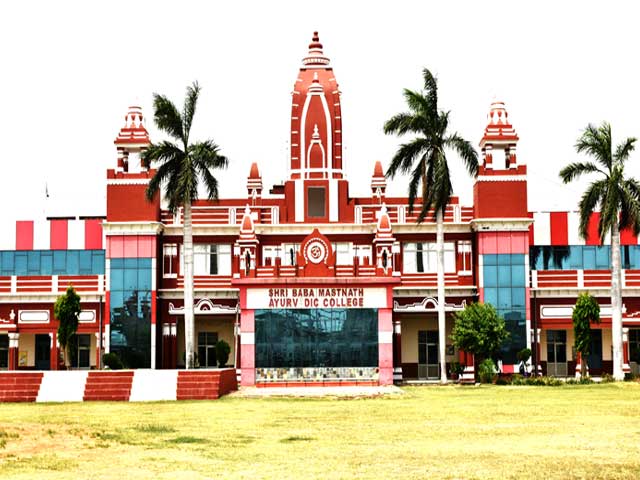
Introduction about Ph.D. in Sanskrit at Baba Mastnath University
Embarking on a Ph.D. in Sanskrit at Baba Mastnath University opens a gateway to profound scholarly exploration of India's oldest linguistic heritage. This doctoral programme blends rigorous research methodology with timeless wisdom, empowering professionals, academicians, and language enthusiasts to become torchbearers of Sanskrit studies. Whether you aim to contribute to classical literature, linguistic analysis, or interdisciplinary applications, this course equips you with the expertise to make a lasting impact.
Eligibility Criteria for Ph.D. in Sanskrit at Baba Mastnath University
Candidates must satisfy the following minimum requirements:
- Master’s degree in Sanskrit or a related discipline with at least 55% marks (or equivalent CGPA).
- Valid National Eligibility Test (NET) qualification in Sanskrit or an equivalent UGC‑approved test.
- For research scholars from other streams, a minimum of 60% in the master’s programme and a satisfactory interview are required.
- Age limit: No upper age restriction, but candidates should demonstrate research aptitude.
Meeting these criteria ensures readiness for the advanced scholarly journey that lies ahead.
Entrance Exam for Ph.D. in Sanskrit at Baba Mastnath University
The university conducts a two‑stage selection process:
- Written Test: Designed to assess proficiency in Sanskrit grammar, literature, and research methodology. The test comprises 100 multiple‑choice questions lasting 2 hours.
- Personal Interview (PI): Evaluates research interests, analytical abilities, and alignment with faculty expertise. Candidates may also be asked to present a research proposal.
Preparation resources, past papers, and mock tests are available on the university’s official portal.
Fee Structure for Ph.D. in Sanskrit at Baba Mastnath University
The fee schedule is modest, reflecting the university’s commitment to accessible higher education. The table below outlines the annual cost breakdown for the regular mode (full‑time) and the part‑time mode:
| Component | Full‑Time (INR) | Part‑Time (INR) |
|---|---|---|
| Tuition Fee | 25,000 | 30,000 |
| Library & Lab Charges | 5,000 | 5,000 |
| Examination & Evaluation Fee | 3,000 | 3,500 |
| Annual Development Fund | 2,000 | 2,500 |
| Total (per annum) | 35,000 | 41,000 |
Scholarships and fee waivers are available for meritorious candidates and those from economically weaker sections (EWS). For detailed financial assistance information, refer to the PhD Admission Assistance service.
Admission Process for Ph.D. in Sanskrit at Baba Mastnath University
The admission journey follows a structured timeline:
- Online Application: Submit the completed form via the university’s admission portal.
- Document Upload: Attach scanned copies of degree certificates, mark sheets, NET scorecard, and identity proof.
- Entrance Examination: Appear for the written test on the scheduled date.
- Interview & Proposal Review: Qualify for the PI and present a brief research proposal.
- Final Admission Letter: Receive an official offer and registration instructions.
Prospective scholars are encouraged to track each step through the portal’s status tracker.
Ph.D. Subjects and Specializations in Sanskrit at Baba Mastnath University
The programme offers a comprehensive range of specializations, allowing candidates to tailor their research focus:
- Vedic Studies and Rituals
- Classical Sanskrit Literature (Mahakavya, Nataka, Kavya)
- Sanskrit Linguistics and Philology
- Comparative Indo‑Aryan Linguistics
- Digital Humanities and Sanskrit Computing
- Philosophical Texts (Darshana, Nyaya, Vedanta)
- Medicine and Ayurveda Textual Analysis
- Epigraphy and Archaeological Inscriptions
Interdisciplinary pathways are also encouraged, linking Sanskrit with fields such as philosophy, computer science, and cultural studies.
Research Areas in Sanskrit at Baba Mastnath University
Faculty members actively lead projects in these cutting‑edge domains:
- Manuscript Preservation and Critical Editing
- Computational Linguistics for Sanskrit (Natural Language Processing)
- Historical Linguistics and Language Evolution
- Interpretation of Vedic Rituals in Contemporary Contexts
- Sanskrit‑Based Knowledge Systems in Modern Education
- Translational Studies: Sanskrit to Regional Languages
- Gender Studies in Classical Texts
Prospective Ph.D. candidates can align their proposals with these thematic clusters to leverage faculty expertise.
Documents Required for Ph.D. in Sanskrit at Baba Mastnath University
A systematic checklist ensures a smooth application:
| Document | Details |
|---|---|
| Application Form | Online submission with a nominal processing fee |
| Master’s Degree Certificate & Transcripts | Original plus scanned copy (PDF) |
| NET / GATE Scorecard | Valid for the subject of Sanskrit |
| Research Proposal (2,500 words) | Including objectives, methodology, and bibliography |
| Curriculum Vitae (CV) | Professional and academic achievements |
| Identity Proof | Aadhaar/PAN/Passport |
| Reservation Certificate (if applicable) | SC/ST/OBC/EWS |
Baba Mastnath University Ph.D. Syllabus for Sanskrit
The structured syllabus is divided into two phases:
- Phase I (Coursework): Core modules covering Advanced Sanskrit Grammar, Research Methodology, Digital Textual Criticism, and Teaching Pedagogy.
- Phase II (Research): Dedicated time for dissertation work, periodic seminars, and publication of at least one peer‑reviewed article.
The syllabus is regularly updated to incorporate emerging research tools, such as Machine Learning for Sanskrit Texts.
Baba Mastnath University Research Methodology for Ph.D. in Sanskrit
The university emphasizes a blend of qualitative and quantitative approaches:
- Textual Analysis and Critical Edition Techniques
- Fieldwork for oral traditions and living Sanskrit practices
- Statistical Modeling for linguistic pattern recognition
- Digital Mapping of Manuscript Collections
Students receive hands‑on training through workshops led by experts from the Research Paper Writing Services team, ensuring methodological rigor.
Highlights of Ph.D. in Sanskrit at Baba Mastnath University
| Feature | Description |
|---|---|
| Experienced Faculty | Renowned scholars with extensive publications in Vedic and Classical Sanskrit. |
| State‑of‑the‑Art Library | Over 30,000 volumes, rare manuscripts, and digital repositories. |
| Interdisciplinary Collaboration | Joint projects with departments of Computer Science, History, and Philosophy. |
| Funding Opportunities | Scholarships, research grants, and project‑based stipends. |
| Career Services | Dedicated placement cell and alumni network for academic and corporate roles. |
How To Apply for Ph.D. in Sanskrit at Baba Mastnath University
Follow these step‑by‑step instructions:
- Visit the official PhD Admission Assistance page for the latest notification.
- Create a user account on the university’s admission portal.
- Complete the online application form, ensuring accurate personal and academic details.
- Upload all required documents (as per the checklist above).
- Pay the non‑refundable application fee via net banking or UPI.
- Schedule your entrance exam slot and download the admit card.
- After clearing the exam, attend the personal interview and submit your research proposal.
- Receive the admission offer, complete registration, and commence coursework.
Career Scope and Job Opportunities After Ph.D. in Sanskrit from Baba Mastnath University
A doctorate in Sanskrit opens diverse avenues:
- Academic Positions: Lecturer, Assistant Professor, Reader, and Professor in universities and colleges worldwide.
- Research Fellowships: Opportunities with CSIR, UGC, and international research institutes.
- Publishing & Editorial Roles: Editorial boards of Sanskrit journals and publishing houses.
- Digital Humanities: Content development for e‑learning platforms, corpus creation, and software localization.
- Government & Cultural Agencies: Roles in the Ministry of Culture, Archaeological Survey of India, and state heritage departments.
- Consultancy: Providing expertise for translation projects, patent documentation in traditional medicine, and linguistic policy formulation.
To enhance employability, consider availing the Research Publication Support and Patent Filing and Support Services.




