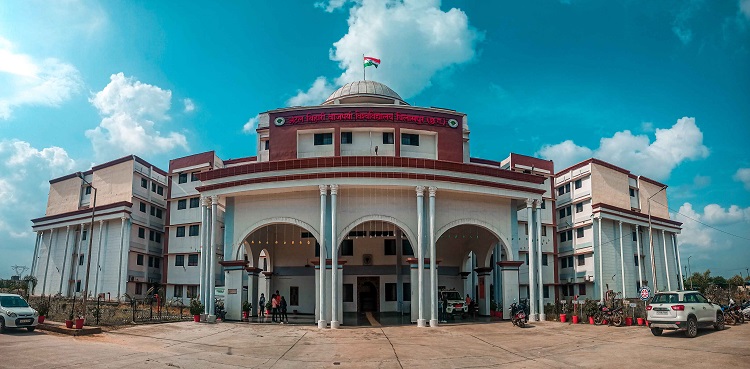
Introduction about Ph.D. in Computer Science at Atal Bihari Vajpayee Vishwavidyalaya
Embarking on a journey toward a Ph.D. in Computer Science at Atal Bihari Vajpayee Vishwavidyalaya (ABVV), formerly known as Bilaspur University, is more than just an academic pursuit; it is a commitment to pioneering innovation in the digital age. In an era where technology dictates the pace of global progress, attaining a doctorate is the ultimate gateway for professionals to transform from industry practitioners into visionary thought leaders. Atal Bihari Vajpayee Vishwavidyalaya offers a robust research ecosystem in Chhattisgarh, designed to nurture intellectual curiosity and technical mastery. Whether your passion lies in Artificial Intelligence, Cyber Security, or Advanced Computing, this program provides the academic rigor and mentorship necessary to redefine the boundaries of what is possible in the technological landscape.
Ph.D Admission 2026-2027 & Writing Support Services by Shiksha Research
For many researchers, the journey starts with meticulous planning. Navigating the complexities of research drafting can be daunting, which is why many scholars seek professional Editing and Proofreading Services to ensure their work meets global scholarly standards. At ABVV, the program is tailored to bridge the gap between theoretical frameworks and industrial application, making it an ideal choice for forward-thinking professionals.
Eligibility Criteria for Ph.D. in Computer Science at Atal Bihari Vajpayee Vishwavidyalaya
To secure a seat in this prestigious research program, candidates must meet the stringent eligibility criteria set by the university in accordance with UGC guidelines. The primary requirement is a Master?s degree (M.Tech, M.E., M.C.A., or M.Sc. in Computer Science/IT) from a recognized university. Candidates must have secured a minimum of 55% marks (or an equivalent grade in a point scale) in their postgraduate studies. A relaxation of 5% is typically provided to candidates belonging to SC/ST/OBC (non-creamy layer) and differently-abled categories.
Aspiring candidates who have already cleared national-level examinations like UGC-NET (including JRF), CSIR-NET, GATE, or SLET are often given preference. For those who are currently working and wish to pursue research, a "No Objection Certificate" (NOC) from their employer is mandatory. If you are struggling with the initial phase of your research journey, seeking PhD Topic Selection and Proposal Assistance can significantly enhance your chances of acceptance.
Entrance Exam for Ph.D. in Computer Science at Atal Bihari Vajpayee Vishwavidyalaya
Admission to the Ph.D. program is primarily facilitated through the Doctoral Entrance Test (DET) conducted by Atal Bihari Vajpayee Vishwavidyalaya. The entrance exam is designed to test the candidate?s analytical abilities, research aptitude, and core subject knowledge. The paper is usually divided into two sections: Research Methodology and Core Computer Science subjects.
Candidates must score a minimum of 50% in the DET to qualify for the interview round. However, exemptions from the entrance test are granted to candidates who have qualified for NET/JRF/GATE or have an M.Phil. degree through a regular program. For those looking for expert guidance through this competitive phase, PhD Admission Assistance can provide the necessary roadmap to navigate university-specific requirements.
Fee Structure for Ph.D. in Computer Science at Atal Bihari Vajpayee Vishwavidyalaya
The fee structure at Atal Bihari Vajpayee Vishwavidyalaya is designed to be affordable while maintaining high standards of academic resources. The fees cover various components including registration, course work, laboratory charges, and thesis evaluation. Below is an approximate breakdown of the fee structure:
| Fee Component | Approximate Amount (INR) | Frequency |
|---|---|---|
| Registration/Application Fee | ?1,500 - ?2,500 | One-time |
| Ph.D. Course Work Fee | ?10,000 - ?15,000 | One-time |
| Annual Tuition/Research Fee | ?15,000 - ?25,000 | Per Annum |
| Laboratory/Library Fee | ?5,000 | Per Annum |
| Thesis Submission & Examination Fee | ?15,000 - ?20,000 | At the time of submission |
Note: The fees mentioned above are indicative and subject to change per university notifications. Additional costs may apply for defense and departmental activities.
Admission Process for Ph.D. in Computer Science at Atal Bihari Vajpayee Vishwavidyalaya
The admission process at ABVV is a multi-step journey focused on identifying the most capable research minds. The process typically proceeds as follows:
- Notification: The university releases an official advertisement on its web portal regarding Ph.D. vacancies.
- Online Application: Interested candidates must submit their application forms along with relevant documents.
- Entrance Test (DET): Qualified applicants (non-exempt) sit for the entrance examination.
- Interview/Viva-Voce: Shortlisted candidates are called for an interview where they present their research interests before the Departmental Research Committee (DRC).
- Merit List: A final merit list is prepared based on entrance scores and interview performance.
- Course Work: Selected candidates undergo a mandatory six-month course work program.
For seasoned professionals who have made significant contributions to the field without following the traditional academic route, exploring Honorary Doctorate Programs might be a viable alternative to acknowledge their lifelong achievements.
Ph.D. Subjects and Specializations in Computer Science at Atal Bihari Vajpayee Vishwavidyalaya
The doctoral program offers a wide array of specializations, allowing students to focus on niche areas of modern computing. These specializations are designed to address current industry demands and future technological trends. Key specializations include:
- Data Science and Big Data Analytics
- Artificial Intelligence and Machine Learning
- Network Security and Cryptography
- Cloud Computing and Distributed Systems
- Software Engineering and Quality Assurance
- Internet of Things (IoT) and Embedded Systems
- Natural Language Processing (NLP)
- Image Processing and Computer Vision
Research Areas in Computer Science at Atal Bihari Vajpayee Vishwavidyalaya
Research at ABVV is not just theoretical; it is about solving real-world problems. The department encourages interdisciplinary research that merges computer science with biology, finance, and social sciences. Extensive support is provided for scholars aiming for Research Publication Support to ensure their findings reach high-impact journals (Scopus, Web of Science). Major research areas include:
- Intelligent Systems: Developing algorithms for autonomous systems and robotics.
- Cyber Security: Researching blockchain technology and advanced threat detection systems.
- Sustainable Computing: Exploring green energy-efficient computing architectures.
- Bioinformatics: Using computational tools to analyze complex biological data.
- Wireless Sensor Networks: Optimizing data flow in massive IoT environments.
Documents Required for Ph.D. in Computer Science at Atal Bihari Vajpayee Vishwavidyalaya
Ensuring you have the correct documentation is vital for a smooth admission process. The university requires verified copies of the following:
| Document Type | Details |
|---|---|
| Academic Transcripts | 10th, 12th, Graduation, and Post-Graduation Marksheets |
| Degree Certificates | Provisional or Original Certificates of UG and PG degrees |
| Entrance Scorecard | NET/GATE/SET/DET scorecard |
| Identity Proof | Aadhar Card, PAN Card, or Passport |
| Research Proposal | A detailed synopsis of the proposed research work |
| Category Certificate | Caste certificate (if applicable) for reservation benefits |
| Experience Certificate | Work experience certificates (if applicable) |
Atal Bihari Vajpayee Vishwavidyalaya Ph.D. Syllabus for Computer Science
The syllabus for the Ph.D. program is structured to transform a student into an independent researcher. It is divided into course work and the subsequent research phase. The course work typically includes:
- Paper I: Research Methodology - Covers quantitative methods, statistical analysis, computer applications in research, and research ethics.
- Paper II: Advanced Subject Review - In-depth study of the chosen specialization (e.g., Advanced AI or Data Mining).
- Paper III: Literature Review - Writing and presenting a comprehensive review of existing literature in the specific research area.
- Research Ethics & Publication: Learning about plagiarism, IPR, and the ethics of data handling.
During the research phase, scholars are encouraged to protect their innovations. Expert Patent Filing and Support Services can assist in securing intellectual property rights for original technological inventions developed during the Ph.D.
How To Apply for Ph.D. in Computer Science at Atal Bihari Vajpayee Vishwavidyalaya
Applying for a Ph.D. requires precision and attention to detail. Follow these steps to ensure a successful application:
- Visit the Portal: Go to the official ABVV university website and navigate to the "Admission" or "Ph.D. Cell" section.
- Register: Create a user profile using a valid email and phone number.
- Fill the Form: Enter academic details, professional experience, and choose "Computer Science" as your subject.
- Upload Documents: Ensure all scanned copies of documents are within the specified size limits.
- Payment: Pay the application fee through the integrated online payment gateway.
- Submit and Print: Finalize the submission and keep a printed copy of the application and fee receipt for future correspondence.
Career Scope and Job Opportunities After Ph.D. in Computer Science from Atal Bihari Vajpayee Vishwavidyalaya
The completion of a Ph.D. opens up a world of elite career opportunities. You are no longer just a developer or an analyst; you are an expert and a creator of knowledge. The career scope includes:
- Academic Leadership: Professors and Deans at prestigious universities worldwide.
- R&D Scientist: Leading Research and Development wings at tech giants like Google, Microsoft, IBM, or ISRO.
- Data Scientist/Architect: Designing complex systems for high-level data interpretation and strategy.
- Independent Consultant: Providing high-value technical consultancy to government and private organizations.
- Entrepreneurship: Founding tech startups based on proprietary research and patented technologies.
Scholarship for Ph.D. in Computer Science at Atal Bihari Vajpayee Vishwavidyalaya
Financial constraints should not hinder the pursuit of knowledge. ABVV assists students in accessing various funding opportunities. Full-time research scholars who have qualified JRF are eligible for significant monthly fellowships. Additionally, the State Government of Chhattisgarh offers various scholarships for SC/ST and minority students. The university also provides merit-based stipends for exceptional scholars, and many research projects funded by agencies like SERB, DST, or AICTE offer Junior Research Fellow (JRF) or Senior Research Fellow (SRF) positions within the department.
FAQs Regarding Ph.D. in Computer Science at Atal Bihari Vajpayee Vishwavidyalaya
1. What is the duration of the Ph.D. program at ABVV?
The minimum duration is three years, including course work, and the maximum duration is usually six years. Extensions may be granted under special circumstances as per university norms.
2. Can I pursue a Ph.D. in Computer Science while working?
Yes, professionals can pursue a Ph.D. as part-time scholars, provided they fulfill the residency requirements for course work and obtain an NOC from their employer.
3. Is the Ph.D. from Atal Bihari Vajpayee Vishwavidyalaya UGC recognized?
Absolutely. Atal Bihari Vajpayee Vishwavidyalaya is a state university recognized by the UGC, and its Ph.D. degrees are valid for all government and private sector jobs globally.
4. How important is the research proposal for the interview?
The research proposal is crucial. It demonstrates your clarity of thought, understanding of the subject, and the feasibility of your research plan to the selection committee.
5. Are there any hostel facilities for Ph.D. scholars?
Yes, the university provides hostel facilities for outstation students, though it is subject to availability and merit list ranking.




