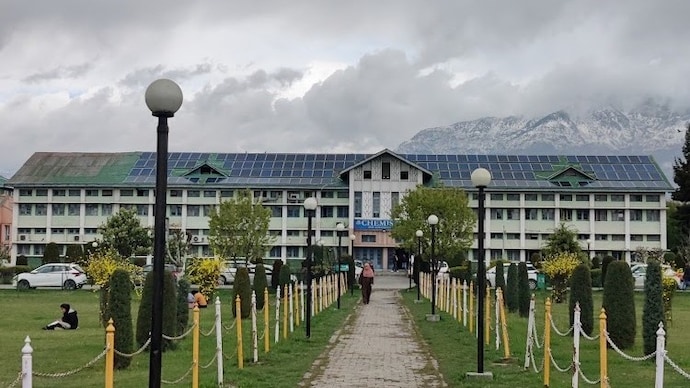
Ph.D. in Earth and Environmental Science from Kashmir University
Embarking on a doctoral journey in Earth and Environmental Science at Kashmir University empowers professionals to lead cutting?edge research that tackles climate change, natural resource management, and sustainable development. This comprehensive guide outlines every crucial aspect?from eligibility rules to career pathways?so you can chart a confident route to academic excellence and impactful discovery.
Eligibility Criteria for Ph.D. in Earth and Environmental Science at Kashmir University
Prospective candidates must satisfy the following baseline requirements:
- Master?s degree (M.Sc., M.Tech., M.Phil.) in Earth Sciences, Environmental Science, Geology, Geography, or a closely related discipline with at least 55% marks (or an equivalent CGPA).
- Nationally recognized entrance qualifications such as GATE, CSIR?UGC NET, or any university?conducted Ph.D. entrance test.
- For candidates holding a B.Tech/M.Tech in a related engineering stream, a minimum of 60% marks is mandatory.
- English proficiency is essential for research documentation, although no separate language test is required.
Entrance Exam for Ph.D. in Earth and Environmental Science at Kashmir University
Kashmir University conducts a two?stage entrance evaluation:
- Written Examination ? 100 multiple?choice questions covering core topics such as Geochemistry, Remote Sensing, Climate Dynamics, Hydrogeology, and Environmental Modelling. The exam lasts for 2 hours.
- Interview & Viva Voce ? Candidates are assessed on research aptitude, analytical thinking, and alignment with faculty expertise.
Preparation tips include reviewing the latest PhD Topic Selection and Proposal Assistance resources, mastering quantitative methods, and staying updated on recent publications in Earth System Sciences.
Fee Structure for Ph.D. in Earth and Environmental Science at Kashmir University
| Component | Annual Amount (INR) | Notes |
|---|---|---|
| Tuition Fee | 12,000 | Standard fee for all Ph.D. programmes. |
| Laboratory & Fieldwork Charges | 6,500 | Includes equipment usage, GIS software licenses, and field expedition support. |
| Library & Digital Resource Subscription | 2,000 | Access to journals, databases, and e?books. |
| Administration & Examination Fee | 1,500 | Covering registration and assessment processing. |
| Total (Approx.) | 22,000 | Subject to yearly revision by the university finance office. |
Students may apply for tuition waivers, research grants, or external scholarships to offset the fee burden.
Admission Process for Ph.D. in Earth and Environmental Science at Kashmir University
- Online Application ? Fill the official portal form, upload academic transcripts, and pay the non?refundable application fee.
- Document Verification ? Submit original certificates for degree, marksheet, and identity proof at the university?s Admissions Office.
- Entrance Examination ? Appear for the written test as per the announced schedule.
- Interview & VIVA ? Shortlisted candidates undergo a panel interview with faculty members.
- Final Selection & Offer Letter ? Successful candidates receive an admission letter containing roll number, fee details, and registration instructions.
For personalized guidance, consider the PhD Admission Assistance service, which offers end?to?end support from application drafting to interview preparation.
Ph.D. Subjects and Specializations in Earth and Environmental Science at Kashmir University
The doctoral programme offers a flexible slate of specializations, allowing scholars to tailor their research focus:
- Geochemistry & Isotope Geology
- Hydrogeology & Water Resource Management
- Climatology & Atmospheric Sciences
- Remote Sensing & GIS Applications
- Environmental Impact Assessment (EIA)
- Ecology & Biodiversity Conservation
- Geotechnical Engineering & Rock Mechanics
Research Areas in Earth and Environmental Science at Kashmir University
Faculty members are engaged in pioneering projects spanning:
- Glacial melt dynamics and downstream water security in the Himalayas.
- Carbon sequestration potential of alpine soils.
- Modeling the impacts of climate variability on monsoon patterns.
- Pollution mapping using satellite?derived aerosol optical depth.
- Geohazard assessment for landslides and seismic activity.
- Renewable energy resource evaluation, particularly micro?hydro and solar potential in mountainous regions.
Documents Required for Ph.D. in Earth and Environmental Science at Kashmir University
| Document | Format | Remarks |
|---|---|---|
| Application Form (online) | PDF/Online | Completed and signed. |
| Academic Transcripts & Degree Certificates | Scanned PDF (JPEG acceptable) | Originals for verification. |
| Entrance Exam Scorecard | GATE/NET or university test. | |
| Research Proposal (2,000?3,000 words) | Word Document | Must include objectives, methodology, and expected outcomes. |
| Curriculum Vitae | Highlight publications, projects, and conference participation. | |
| Letter of Recommendation (2) | PDF (signed) | From academicians familiar with your research potential. |
Kashmir University Ph.D. Syllabus for Earth and Environmental Science
The syllabus is structured around three core modules, each culminating in a comprehensive evaluation:
- Foundations of Earth System Science ? Core concepts in geology, climatology, hydrology, and environmental chemistry.
- Research Methodology & Data Analytics ? Advanced statistical tools, GIS, remote sensing techniques, and scientific writing.
- Specialization?Specific Coursework ? Tailored seminars and lab work aligned with the chosen research domain (e.g., glaciology, pollution monitoring).
How To Apply for Ph.D. in Earth and Environmental Science at Kashmir University
Follow these step?by?step instructions to submit a successful application:
- Visit the official Kashmir University Admissions Portal and create a user account.
- Complete the online Ph.D. application form, ensuring all fields are accurately filled.
- Upload scanned copies of the required documents (refer to the Documents Required table).
- Pay the application fee via the integrated payment gateway.
- Print the acknowledgment receipt and keep it for future reference.
- Monitor your email for notification of the written test schedule and interview invitation.
Career Scope and Job Opportunities After Ph.D. in Earth and Environmental Science from Kashmir University
Graduates emerge as experts equipped to influence policy, drive innovation, and lead research teams. Potential career avenues include:
- Senior Research Scientist ? National institutions (e.g., Indian Institute of Tropical Meteorology, CSIR?NGRI).
- University Faculty ? Assistant/Associate Professor positions with research grant opportunities.
- Environmental Consultant ? Advising governments and private firms on sustainability initiatives.
- Project Manager ? Overseeing large?scale climate adaptation or water resource projects.
- Science Communicator ? Writing for scientific journals, policy briefs, and public outreach.
- Policy Analyst ? Contributing to environmental legislation at state and national levels.
Scholarship for Ph.D. in Earth and Environmental Science at Kashmir University
The university offers several financial assistance schemes:
- University Merit Scholarship ? Covers tuition and provides a monthly stipend of INR 12,000 for top?ranked candidates.
- UGC?JRF (Junior Research Fellowship) ? Competitive national award offering a stipend of INR 31,000 per month.
- External Grants ? Funding from agencies such as the Ministry of Science & Technology, ISRO, and international bodies (e.g., UNESCO, EU Horizon).
To enhance your scholarship application, consider engaging with the Editing and Proofreading Services to polish research proposals and CVs.
FAQs Regarding Ph.D. in Earth and Environmental Science at Kashmir University
- 1. What is the minimum duration of the Ph.D. program?
- Typically 3?4 years, contingent on research progress and publication requirements.




