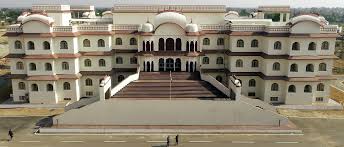
Ph.D. in Journalism And Mass Communication from Pandit Deendayal Upadhyaya Shekhawati University
Introduction about Ph.D. in Journalism And Mass Communication at Pandit Deendayal Upadhyaya Shekhawati University
Pandit Deendayal Upadhyaya Shekhawati University (PDUSU) offers a rigorous and research‑oriented Doctoral programme in Journalism and Mass Communication. Designed for academicians, industry veterans, and media professionals, the Ph.D. empowers scholars to explore the evolving dynamics of digital media, public communication, and ethical journalism. The curriculum blends theoretical frameworks with practical investigations, enabling candidates to contribute original knowledge to the rapidly changing communication landscape.
Eligibility Criteria for Ph.D. in Journalism And Mass Communication at Pandit Deendayal Upadhyaya Shekhawati University
- Master’s degree in Journalism, Mass Communication, Media Studies, or any related discipline with a minimum of 55% aggregate (or equivalent grade).
- Qualifying national level examinations such as UGC‑NET, CSIR‑NET, or university‑conducted Ph.D. entrance test.
- For candidates with a Ph.D. in a complementary field (e.g., Sociology, Political Science, Information Technology), a minimum of 50% in the master’s programme may be considered.
- Applicants must possess a valid score in English proficiency (IELTS/TOEFL) if the medium of instruction is English and the candidate’s prior education was in another language.
Entrance Exam for Ph.D. in Journalism And Mass Communication at Pandit Deendayal Upadhyaya Shekhawati University
The university conducts its own Ph.D. entrance examination annually. The test comprises three sections:
- General Aptitude: Logical reasoning, quantitative ability, and data interpretation.
- Subject Knowledge: Core concepts of journalism, mass communication theories, media law, and research methodology.
- Research Proposal Presentation: Candidates present a concise 10‑minute proposal outlining their intended research problem, objectives, and methodology.
Candidates who have cleared UGC‑NET or CSIR‑NET are exempted from the written component but must still attend the interview and proposal presentation. Detailed syllabus and sample question papers are available on the university’s official portal.
Fee Structure for Ph.D. in Journalism And Mass Communication at Pandit Deendayal Upadhyaya Shekhawati University
| Fee Component | Amount (INR) |
|---|---|
| Application Processing Fee | 1,500 |
| Entrance Examination Fee | 2,000 |
| Annual Tuition & Lab Fees | 25,000 |
| Library & Resource Centre Charge | 3,000 |
| Research Material & Publication Support | 5,000 |
| Total Approx. First‑Year Cost | 36,500 |
Admission Process for Ph.D. in Journalism And Mass Communication at Pandit Deendayal Upadhyaya Shekhawati University
- Online Application: Submit the completed application form via the university’s admission portal along with scanned copies of academic transcripts.
- Document Verification: Upload required documents (listed below) and pay the non‑refundable processing fee.
- Entrance Test & Interview: Appear for the written test (if applicable) followed by a personal interview and research proposal defence.
- Admission Offer: Successful candidates receive an admission letter and are required to confirm acceptance within 15 days.
- Enrollment & Fee Payment: Pay the first‑year tuition fee and register for the semester.
Ph.D. Subjects and Specializations in Journalism And Mass Communication at Pandit Deendayal Upadhyaya Shekhawati University
The doctoral programme offers a broad spectrum of specializations, allowing scholars to align their research with personal interests and industry demands:
- Digital Media & New Media Studies
- Media Ethics and Law
- Political Communication
- Health Communication
- Corporate Communication & Public Relations
- Media Audiences & Reception Studies
- Journalistic Research Methods
- Strategic Communication in Development Contexts
Research Areas in Journalism And Mass Communication at Pandit Deendayal Upadhyaya Shekhawati University
Faculty mentors guide research across emerging domains such as:
- Impact of Artificial Intelligence on News Production
- Social Media Algorithms and Public Opinion Formation
- Fake News Detection and Fact‑Checking Mechanisms
- Media Representation of Marginalised Communities
- Effectiveness of Digital Campaigns in Public Health
- Data‑Driven Storytelling and Visual Journalism
- Ethical Implications of Surveillance Journalism
- Cross‑cultural Media Comparisons in Globalization
Documents Required for Ph.D. in Journalism And Mass Communication at Pandit Deendayal Upadhyaya Shekhawati University
| Document | Details / Format |
|---|---|
| Completed Application Form | Online submission with electronic signature |
| Academic Transcripts | Original & attested copies of Master’s & Bachelor’s degrees |
| Entrance Exam Scorecard | UGC‑NET/CSIR‑NET or university entrance test result |
| Research Proposal (1500‑2000 words) | Includes objectives, literature review, methodology |
| Curriculum Vitae (CV) | Professional experience, publications, conferences |
| Proof of Identity | Aadhaar, Passport or Voter ID |
| Category Certificate (if applicable) | SC/ST/OBC/PH |
Pandit Deendayal Upadhyaya Shekhawati University Ph.D. Syllabus for Journalism And Mass Communication
The syllabus is divided into two major phases:
- Coursework (First Year): Core modules covering Advanced Research Methodology, Media Theory, Quantitative & Qualitative Analysis, Ethics in Journalism, and Electives based on chosen specialization.
- Dissertation (Second & Third Year): Original research under the guidance of a faculty supervisor, culminating in a thesis that meets UGC standards for doctoral submissions.
Students are encouraged to publish at least two research papers in peer‑reviewed journals before submission of the final thesis. For assistance with research writing, candidates may avail of Thesis and Dissertation Writing Services, Research Data Analysis Services, Research Paper Writing Services, and Questionnaire Design and Development.
How To Apply for Ph.D. in Journalism And Mass Communication at Pandit Deendayal Upadhyaya Shekhawati University
Applicants must follow these steps:
- Visit the university’s official admission portal and register with a valid email address.
- Fill in personal, academic, and professional details accurately.
- Upload scanned copies of all mandatory documents (see Documents Required section).
- Pay the application fee through NetBanking, Credit/Debit Card, or UPI.
- Submit the research proposal in PDF format (maximum 2,500 words).
- Track application status and schedule the entrance exam date.
- After clearing the entrance test, attend the interview and proposal presentation.
- Confirm admission by paying the first‑year tuition fee within the stipulated deadline.
Career Scope and Job Opportunities After Ph.D. in Journalism And Mass Communication from Pandit Deendayal Upadhyaya Shekhawati University
A doctorate in Journalism and Mass Communication opens diverse career pathways:
- Academic Positions: Assistant Professor, Associate Professor, Department Head, or Research Fellow in universities and institutes.
- Research & Policy: Senior Research Analyst in think‑tanks, governmental agencies, or NGOs focusing on media policy, communication strategies, and public outreach.
- Media Leadership: Editorial Director, Newsroom Manager, or Chief Communications Officer in leading newspapers, TV channels, digital news platforms, and media houses.
- Consultancy: Media strategy consultant for corporations, political parties, or international organisations.
- Content Development: Head of Content, Storytelling Lead, or Producer for multimedia, documentary, and streaming services.
- Freelance & Entrepreneurship: Independent media analyst, author, or founder of media‑tech start‑ups.
The average salary for Ph.D. holders ranges from INR 8 Lakhs to INR 20 Lakhs per annum, depending on the sector and experience.
Scholarship for Ph.D. in Journalism And Mass Communication at Pandit Deendayal Upadhyaya Shekhawati University
The university, in collaboration with governmental bodies and private foundations, offers several financial aid options:
- University Merit Scholarship: Up to 50% tuition waiver for candidates securing a rank within the top 10% of the entrance test.
- UGC‑JRF (Junior Research Fellowship): Annual stipend of INR 31,000 plus contingency grant, awarded on the basis of UGC‑NET performance.
- State Government Scholarships: Reserved for candidates belonging to SC/ST/OBC categories as per Rajasthan state policies.
- External Grants: Opportunities to apply for research funding from the Indian Council of Social Science Research (ICSSR) and Media Development Institute.
FAQs Regarding Ph.D. in Journalism And Mass Communication at Pandit Deendayal Upadhyaya Shekhawati University
- Q: Is work experience required for admission?
- A: No mandatory work experience is required, but professional experience




