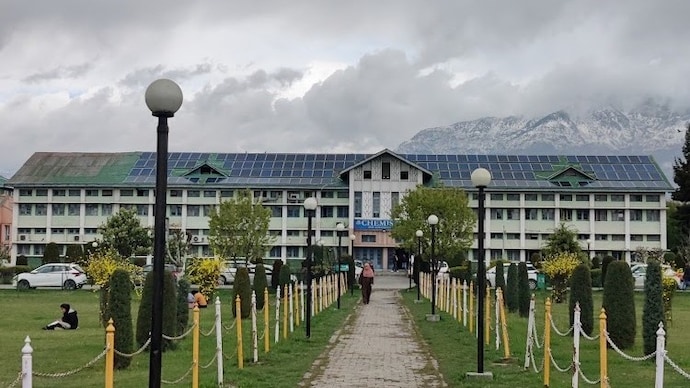
Ph.D. in Nanotechnology from Kashmir University: Eligibility, Entrance Exam, Fee Structure, Admission Process, Subjects, Research Areas, Syllabus, Scholarship & Career Scope
Introduction about Ph.D. in Nanotechnology at Kashmir University
The Doctor of Philosophy (Ph.D.) in Nanotechnology offered by Kashmir University stands at the forefront of cutting?edge research in materials science, electronics, and biomedical engineering. This program equips professionals with deep theoretical knowledge and hands?on expertise to innovate at the atomic and molecular scale. Whether you aim to lead research labs, develop nanodevices, or contribute to industry?driven R&D, the Ph.D. in Nanotechnology at Kashmir University provides a robust academic environment, state?of?the?art facilities, and a vibrant community of scholars.
Eligibility Criteria for Ph.D. in Nanotechnology at Kashmir University
- Master?s degree (M.Sc., M.Tech., M.E.) or equivalent in Nanotechnology, Physics, Chemistry, Materials Science, Electrical Engineering, or a closely related discipline.
- Minimum aggregate of 55?% (or 5.0 on a 10?point scale) in the qualifying master?s program. Candidates with a 5?year integrated B.E./B.Tech. degree must have a minimum of 60?%.
- Valid GATE/NET/CSIR?UGC score is advantageous but not mandatory.
- Candidates must satisfy the age limit of 30?years (relaxations apply for SC/ST/PWD as per university norms).
- Proficiency in English (minimum TOEFL?IBT 60 or IELTS?6.0 for international applicants).
Entrance Exam for Ph.D. in Nanotechnology at Kashmir University
Kashmir University conducts a written entrance test followed by a personal interview. The test evaluates:
- Fundamental concepts of nanoscience and nanotechnology.
- Analytical and problem?solving abilities.
- Research aptitude and familiarity with contemporary literature.
Preparation resources such as previous year papers, standard textbooks, and online modules are recommended. Successful candidates receive a provisional admission subject to interview performance.
Fee Structure for Ph.D. in Nanotechnology at Kashmir University
| Category | Annual Fee (INR) | One?Time Charges |
|---|---|---|
| General Category | 15,000 | Registration: 2,000 |
| SC/ST/PWD | 8,000 (50?% concession) | Registration: 1,000 |
| Scholarship Recipients | 0 (Fully Waived) | None |
Additional expenses such as laboratory consumables, field trips, and conference participation are borne by the student unless covered by research grants.
Admission Process for Ph.D. in Nanotechnology at Kashmir University
- Online Application: Fill the admission form on the university portal and upload scanned copies of academic certificates.
- Application Fee Payment: Pay the non?refundable fee through net banking or credit card.
- Entrance Examination: Appear for the written test scheduled by the Department of Nanotechnology.
- Interview: Shortlisted candidates are invited for a personal interview and research proposal discussion.
- Final Offer: Admission letter is issued to successful candidates, followed by enrollment and fee payment.
Ph.D. Subjects and Specializations in Nanotechnology at Kashmir University
Students can tailor their research across a spectrum of specializations:
- Nanomaterials Synthesis & Characterization
- Nanoelectronics & Device Engineering
- Nanomedicine & Drug Delivery Systems
- Nanophotonics & Plasmonics
- Environmental Nanotechnology
- Computational Nanoscience
Research Areas in Nanotechnology at Kashmir University
The department focuses on interdisciplinary research that addresses global challenges. Key research clusters include:
- Energy?efficient nano?solar cells and photocatalysts.
- Smart nanosensors for real?time health monitoring.
- Graphene?based flexible electronics.
- Nanostructured membranes for water purification.
- Quantum dot synthesis for optoelectronic applications.
Documents Required for Ph.D. in Nanotechnology at Kashmir University
| Document | Details |
|---|---|
| Academic Transcripts | Certified copies of all degrees (with attestation). |
| Research Proposal | 2?page outline of intended research topic. |
| Entrance Exam Scorecard | Official result of the university?conducted test. |
| Identification Proof | Aadhaar / Passport copy. |
| Passport?size Photographs | Four recent color photographs. |
Kashmir University Ph.D. Syllabus for Nanotechnology
The syllabus is designed to build a solid foundation before advancing to specialized topics. Core modules include:
- Fundamentals of Nanoscience
- Advanced Materials Characterization Techniques
- Quantum Mechanics for Nanostructures
- Nanofabrication Processes
- Statistical Mechanics & Thermodynamics at Nanoscale
- Research Methodology and Scientific Writing
Elective courses are chosen based on the chosen specialization and may involve lab rotations, industry collaborations, or interdisciplinary seminars.
How To Apply for Ph.D. in Nanotechnology at Kashmir University
Follow these concise steps to submit a successful application:
- Visit the official Kashmir University website and navigate to the ?Post?Graduate Admissions? section.
- Download the Ph.D. application form or complete it online.
- Prepare a concise research proposal (max 2 pages) highlighting the problem statement, objectives, and proposed methodology.
- Upload scanned copies of academic certificates, identity proof, and passport?size photographs.
- Pay the application fee and note the transaction ID for reference.
- Submit the form and keep a copy of the acknowledgment for future correspondence.
For assistance with proposal drafting, consider the PhD Topic Selection and Proposal Assistance service.
Career Scope and Job Opportunities After Ph.D. in Nanotechnology from Kashmir University
A doctorate in Nanotechnology opens doors to high?impact roles across academia, industry, and government. Typical career trajectories include:
- Assistant/Associate Professor or Research Scientist in universities and research institutes.
- R&D Engineer or Nano?process Engineer in semiconductor, aerospace, and biotech firms.
- Scientific Consultant for governmental agencies focusing on nanotech policy and safety.
- Entrepreneur ? launching startups in nano?materials, diagnostics, or clean?energy solutions.
- Patent Analyst or Intellectual Property Specialist, especially when supported by Patent Filing and Support Services.
According to recent industry surveys, the average salary for nanotechnology Ph.D. holders in India ranges from INR?8?lakh to INR?20?lakh per annum, with rapid growth in specialized sectors such as quantum computing and nanomedicine.
Scholarship for Ph.D. in Nanotechnology at Kashmir University
Kashmir University offers merit?based scholarships, research assistantships, and external fellowships (e.g., CSIR?JRF, UGC?NET). Eligible candidates receive:
- Full tuition waiver.
- Monthly stipend ranging from INR?15,000 to INR?30,000.
- Travel allowance for conferences and workshops.
For comprehensive editing and manuscript preparation, students can avail Editing and Proofreading Services.
FAQs Regarding Ph.D. in Nanotechnology at Kashmir University
- 1. How long does it take to complete the Ph.D.?
- The typical duration is 3?4 years, subject to satisfactory progress reports and thesis submission.
- 2. Can a working professional enroll part?time?
- Yes, the university permits part?time registration with a flexible schedule, though the research timeline may extend.
- 3. Is there a requirement for publishing papers before thesis submission?
- At least two papers in peer?reviewed journals are recommended; some supervisors may require this as a condition for final evaluation.
- 4. What support is




