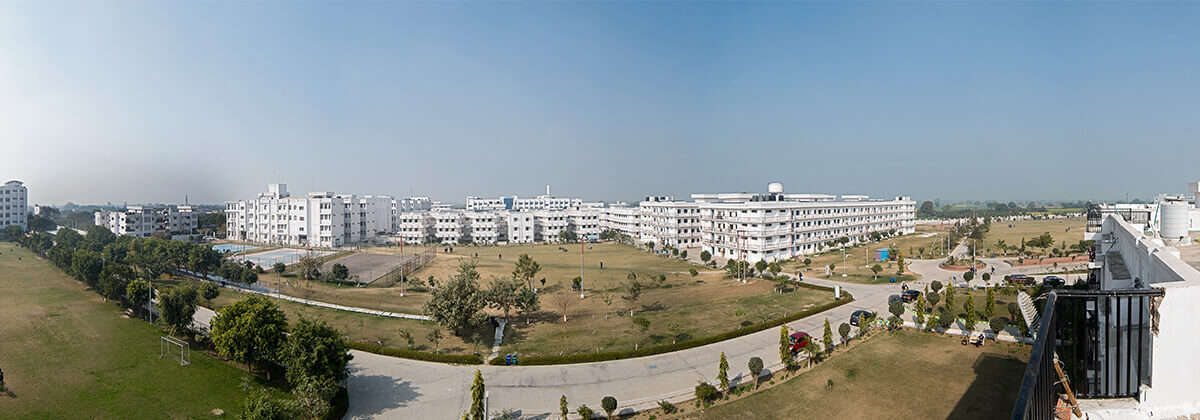
Introduction about Ph.D. in Physics at GLA University
Embarking on a Ph.D. in Physics at GLA University opens a gateway to cutting‑edge research, intellectual rigor, and a future of limitless possibilities. The university’s state‑of‑the‑art laboratories, distinguished faculty, and collaborative research environment are designed to nurture innovators who will shape the next wave of scientific breakthroughs. Whether your passion lies in quantum mechanics, astrophysics, or condensed matter, GLA University offers a vibrant platform to transform curiosity into discovery.
Eligibility Criteria for Ph.D. in Physics at GLA University
Prospective candidates must meet the following academic benchmarks to qualify for the doctoral programme:
- A master's degree (M.Sc., M.Tech., or equivalent) in Physics or a closely related discipline with a minimum aggregate of 55% (or CGPA 6.0/10).
- Qualifying scores in the university‑conducted entrance exam or recognized national tests (e.g., GATE, JEST, CSIR‑NET).
- For candidates holding a B.E./B.Tech. in Engineering Physics, a minimum of 60% is required.
- English proficiency for international applicants (IELTS ≥ 6.0 or TOEFL ≥ 80).
Entrance Exam for Ph.D. in Physics at GLA University
The entrance exam evaluates core physics concepts, analytical abilities, and research aptitude. The test pattern typically includes:
- Section I – Theory: 60 multiple‑choice questions covering Classical Mechanics, Electrodynamics, Thermodynamics, Quantum Theory, and Mathematical Physics.
- Section II – Applied Physics: 20 objective questions on Material Science, Nanotechnology, and Computational Physics.
- Section III – Research Aptitude: A short essay and a presentation of a proposed research topic.
Top performers are invited for a personal interview and a detailed discussion of their research proposal.
Fee Structure for Ph.D. in Physics at GLA University
| Component | Annual Fee (INR) | One‑Time Charges (INR) |
|---|---|---|
| Tuition & Laboratory Charges | 45,000 | — |
| Research Project Grant (subsidized) | — | 30,000 |
| Library & Digital Resources | 5,000 | — |
| Student Services & Welfare | 3,000 | — |
| Security Deposit (refundable) | — | 10,000 |
| Total (approx.) | 53,000 | 40,000 |
Admission Process for Ph.D. in Physics at GLA University
- Online Application: Submit the web‑based application form along with scanned copies of academic transcripts.
- Entrance Examination: Appear for the GLA University Ph.D. entrance test or upload qualifying national test scores.
- Interview & Proposal Review: Shortlisted candidates are called for a faculty interview and a review of their research proposal.
- Document Verification: Provide original documents for verification at the university’s admissions office.
- Admission Offer: Receive the official admission letter, fee payment instructions, and enrolment details.
- Orientation: Attend the mandatory orientation program covering research ethics, campus facilities, and academic expectations.
Ph.D. Subjects and Specializations in Physics at GLA University
GLA University offers diverse specializations that enable doctoral candidates to focus on emerging and traditional fields:
- Quantum Optics & Photonics
- Condensed Matter Physics
- High‑Energy Particle Physics
- Astrophysics & Cosmology
- Plasma Physics
- Computational & Theoretical Physics
- Nanostructured Materials
- Environmental and Atmospheric Physics
Research Areas in Physics at GLA University
Faculty‑guided research clusters align with national priorities and global scientific trends:
- Quantum Information Science: Quantum computing algorithms, entanglement dynamics, and secure communication.
- Renewable Energy Materials: Photovoltaic thin films, perovskite solar cells, and energy‑storage nanocomposites.
- Space Sciences: Satellite instrumentation, cosmic ray detection, and dark matter exploration.
- Biomedical Physics: Imaging techniques, radiation therapy dosimetry, and biosensor development.
- Advanced Simulations: Monte‑Carlo methods, density functional theory, and machine‑learning models for physical systems.
Documents Required for Ph.D. in Physics at GLA University
| Document | Format | Remarks |
|---|---|---|
| Academic Transcripts (M.Sc./M.Tech.) | PDF (max 2 MB) | Official sealed copies uploaded |
| Degree Certificate | PDF (max 2 MB) | Original scanned copy |
| Entrance Exam Scorecard | GATE, JEST, CSIR‑NET or GLA University test | |
| Research Proposal (10‑12 pages) | DOCX or PDF | Include objectives, methodology, and bibliography |
| Curriculum Vitae | Highlight publications and project experience | |
| Two Academic References | PDF (letterhead) | Signed and stamped by referees |
| Passport‑Size Photograph | JPEG (300 × 300 px) | White background |
GLA University Ph.D. Syllabus for Physics
The doctoral syllabus is divided into core, elective, and research components:
- Core Modules (Year 1): Advanced Quantum Mechanics, Statistical Mechanics, Electrodynamics, Computational Physics.
- Electives (Year 2): Choose any three from Astrophysics, Nanotechnology, Plasma Physics, Soft Condensed Matter, Biological Physics.
- Research Work (Year 2‑4): Laboratory experiments, simulation projects, and dissertation writing under the guidance of a dedicated supervisor.
How To Apply for Ph.D. in Physics at GLA University
Follow these step‑by‑step instructions to submit a successful application:
- Visit the official GLA University Ph.D. portal and click “Apply Now”.
- Create a user account using your email address and set a secure password.
- Complete the online application form—fill in personal details, academic history, and upload the required documents.
- Pay the non‑refundable application fee of INR 2,500 through the integrated payment gateway.
- Schedule your entrance examination date and download the admit card.
- After clearing the exam, await the interview invitation sent via email.
- Confirm your seat by paying the initial tuition installment within the stipulated deadline.
Career Scope and Job Opportunities After Ph.D. in Physics from GLA University
A doctorate in physics equips you with analytical acumen and problem‑solving expertise valued across sectors. Potential career pathways include:
- Academia: Assistant Professor, Post‑Doctoral Fellow, Research Scientist.
- Research Institutions: Senior Scientist at ISRO, DRDO, Bhabha Atomic Research Centre, or international labs such as CERN.
- Industry: R&D roles in semiconductor, aerospace, renewable energy, and data analytics firms.
- Government & Policy: Science advisor, technology policy analyst, or grants manager.
- Entrepreneurship: Founder of tech‑based startups focusing on quantum devices or nanomaterials.
GLA University’s strong industry linkages and alumni network significantly boost placement prospects, ensuring that graduates are well‑positioned for high‑impact roles worldwide.
Scholarship for Ph.D. in Physics at GLA University
Merit‑based and need‑based scholarships are available to support outstanding scholars:
- University Excellence Scholarship: Full tuition waiver for the top 5% of candidates based on entrance scores.
- Research Grant Fellowship: INR 2,00,000 per annum for projects aligned with government‑funded schemes.
- Financial Aid for Economically Disadvantaged Students: Partial fee remission and a monthly stipend of INR 5,000.
- External Fellowships: Eligibility for CSIR‑JRF, UGC‑NET, and DST‑SERB grants.
FAQs Regarding Ph.D. in Physics at GLA University
- 1. What is the minimum duration to complete the Ph.D.?
- The programme is structured for a minimum of 3 years, extendable up to 5 years based on research progress.
- 2. Can I pursue the Ph.D. part‑time while working?
- Yes, GLA University offers a part‑time option for working professionals, with flexible lab access and evening seminars.
- 3. Is there an option to transfer credits from another university?
- Credits from recognized institutions may be considered after evaluation by the Academic Committee.
- 4. Are there any collaborative research opportunities abroad? <dd




