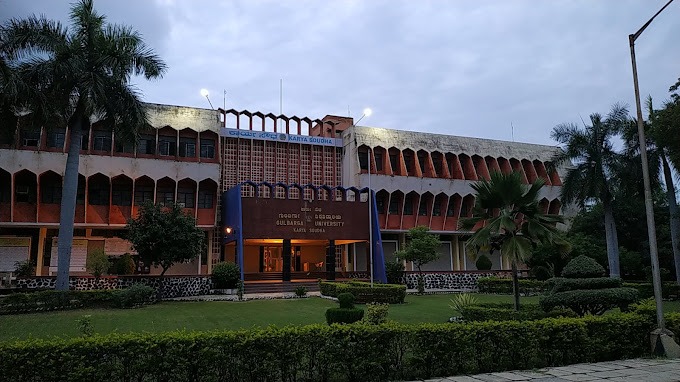
Ph.D. in Physics from Gulbarga University: Eligibility, Entrance Exam, Fee Structure, Admission Process, Subjects, Research Areas, Syllabus, Scholarship & Career Scope
Introduction about Ph.D. in Physics at Gulbarga University
Embarking on a doctoral journey in Physics at Gulbarga University opens doors to cutting‑edge research, visionary mentorship, and a vibrant academic community. As one of Karnataka’s distinguished institutions, Gulbarga University blends state‑of‑the‑art laboratories with interdisciplinary collaborations, empowering scholars to explore quantum phenomena, astrophysical mysteries, and advanced material science. Whether you aim to become a university professor, a research scientist in a national laboratory, or an industry innovator, a Ph.D. in Physics here equips you with the analytical rigor and inventive mindset required to lead the scientific frontier.
Eligibility Criteria for Ph.D. in Physics at Gulbarga University
Prospective candidates must satisfy the following baseline requirements:
- A Master’s degree (M.Sc.) in Physics or a closely related discipline with at least 55 % aggregate marks. Candidates with a first class (≥60 %) are given preference.
- Qualifying the Gulbarga University Ph.D. Entrance Examination or holding a valid national‑level qualifying test such as NET, GATE, or CSIR (UGC).
- English language proficiency is essential for research communication; a minimum of IELTS 6.0 or equivalent is recommended for international aspirants.
- Age is not a restrictive factor, although candidates below 30 years often receive additional merit points.
Entrance Exam for Ph.D. in Physics at Gulbarga University
The university conducts a comprehensive written test followed by an interview to assess both subject mastery and research aptitude. The exam pattern typically includes:
- Four sections – Classical Mechanics, Electromagnetism, Quantum Theory, and Applied Physics.
- Each section carries 25 marks, total duration 2 hours.
- Analytical questions, problem‑solving, and a brief essay on a current research topic.
- The interview evaluates the candidate’s proposed research proposal, literature awareness, and communication skills.
Candidates who clear nationally recognized examinations (e.g., NET, GATE) are exempted from the written test but must still attend the interview.
Fee Structure for Ph.D. in Physics at Gulbarga University
| Fee Component | Amount (INR) | Notes |
|---|---|---|
| Application Processing Fee | 1,500 | One‑time, non‑refundable |
| Annual Tuition Fee | 15,000 | Payable at the start of each academic year |
| Laboratory & Equipment Charges | 5,000 | Includes access to high‑performance computing facilities |
| Library & Resource Subscription | 2,000 | Digital journals and inter‑library loan services |
| Miscellaneous (Sports, Health, etc.) | 3,000 | Optional, varies per student |
| Total Approximate Annual Cost | 26,500 | Excluding scholarships or assistantships |
Financial assistance is available through university‑grant scholarships, research assistantships, and external fellowships, significantly reducing out‑of‑pocket expenses for meritorious students.
Admission Process for Ph.D. in Physics at Gulbarga University
The step‑by‑step admission workflow is designed for transparency and efficiency:
- Online Application – Submit the digital form via the university portal along with scanned copies of academic certificates.
- Document Verification – The admissions office reviews eligibility, qualifying exam scores, and research proposal outlines.
- Entrance Examination – Eligible applicants sit for the written test; exempted candidates directly proceed to the interview.
- Interview & Presentation – Candidates present a concise research plan (10 minutes) followed by a Q&A session with the department panel.
- Final Merit List – Selections are announced based on academic performance, entrance test scores, interview assessment, and availability of research supervisors.
- Enrollment & Fee Payment – Accepted students complete registration, pay the initial fee, and receive their official admission letter.
Ph.D. Subjects and Specializations in Physics at Gulbarga University
Gulbarga University offers a diverse array of research specializations aligned with global scientific challenges:
- Quantum Optics and Quantum Information
- Condensed Matter Physics & Nanostructured Materials
- Astronomy & Astrophysics
- Plasma Physics and Fusion Energy
- Computational Physics & Numerical Modelling
- Medical Physics and Radiation Therapy
- Statistical Mechanics & Complex Systems
Students may tailor their dissertation topics to intersect multiple sub‑fields, fostering interdisciplinary expertise.
Research Areas in Physics at Gulbarga University
Faculty members lead nationally funded projects across the following cutting‑edge domains:
- Topological Insulators and Quantum Hall Effects
- High‑Energy Particle Detection Techniques
- Renewable Energy Materials: Photovoltaics and Thermoelectrics
- Gravitational Wave Data Analysis
- Artificial Intelligence in Material Property Prediction
- Radiation Dosimetry for Cancer Treatment
Collaborations with Indian Space Research Organisation (ISRO), Council of Scientific & Industrial Research (CSIR), and international universities broaden the impact and visibility of doctoral research.
Documents Required for Ph.D. in Physics at Gulbarga University
| Document | Details |
|---|---|
| Completed Application Form | Online submission with digital signature |
| Academic Transcripts | Original mark sheets of B.Sc. and M.Sc. (certified copy) |
| Qualifying Exam Scorecard | NET/GATE/CSIR or Gulbarga University entrance test result |
| Research Proposal | 2‑page document outlining objectives, methodology, and expected outcomes |
| Curriculum Vitae (CV) | Academic and professional achievements, publications, conferences |
| Identity Proof | Aadhar Card / Passport (photocopy) |
| Recent Passport‑Size Photographs | Four color photos, 2 × 2 cm |
All documents must be attested by the issuing authority and uploaded in PDF format (max 2 MB each).
Gulbarga University Ph.D. Syllabus for Physics
The doctoral curriculum is structured to blend coursework, comprehensive exams, and research milestones:
- Core Modules (Year 1) – Advanced Classical Mechanics, Quantum Field Theory, Statistical Physics, Computational Techniques.
- Elective Seminars (Year 2) – Topics chosen based on the student’s research direction, such as Laser Physics, Cosmology, or Biophysics.
- Comprehensive Examination – Conducted at the end of Year 2 to assess depth of knowledge.
- Research Phase (Years 3‑5) – Original investigation, publication in peer‑reviewed journals, and thesis submission.
Regular progress reviews ensure alignment with the university’s academic standards and research ethics.
How To Apply for Ph.D. in Physics at Gulbarga University
Follow this concise roadmap to submit a successful application:
- Visit the official Gulbarga University website and navigate to the Ph.D. Admissions portal.
- Create a user account and fill out the online application form with accurate personal and academic details.
- Upload the required documents (transcripts, scorecards, research proposal, CV, photographs).
- Pay the non‑refundable processing fee through the integrated payment gateway.
- Submit the application before the stipulated deadline (usually the last week of June for the August intake).
- Monitor your registered email for invitation to the entrance test or interview.
For personalized assistance with proposal




