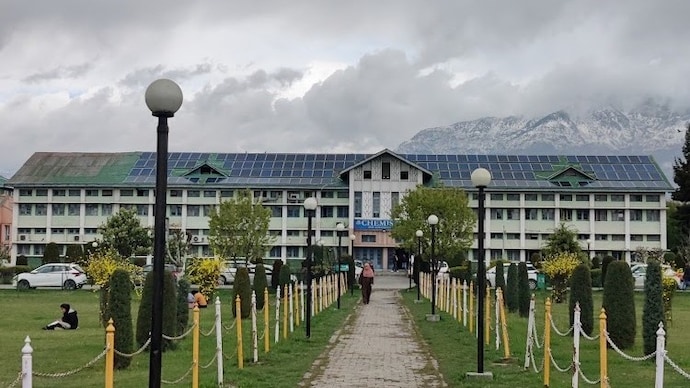
Ph.D. in Physics from Kashmir University: Eligibility, Entrance Exam, Fee Structure, Admission Process, Subjects, Research Areas, Syllabus, Scholarship & Career Scope
Introduction about Ph.D. in Physics at Kashmir University
The Doctor of Philosophy (Ph.D.) in Physics at Kashmir University stands as a beacon for aspiring researchers who aim to push the boundaries of scientific knowledge. Nestled in the vibrant academic ecosystem of the Kashmir Valley, the university offers state‑of‑the‑art laboratories, seasoned faculty, and collaborative research environments that empower scholars to excel. Whether you are driven by a passion for quantum mechanics, condensed matter, or astrophysics, this program equips you with rigorous analytical skills, cutting‑edge methodologies, and a global perspective that can transform your career trajectory.
Eligibility Criteria for Ph.D. in Physics at Kashmir University
Prospective candidates must meet the following criteria to be considered for admission:
- A Master’s degree (M.Sc.) in Physics or a closely related discipline from a recognized university with a minimum of 55% aggregate (or CGPA equivalent).
- Candidates holding a B.E./B.Tech. in Applied Physics or Engineering Physics are also eligible, provided they have cleared requisite postgraduate level physics modules.
- National Eligibility Test (NET) qualification or GATE (Physics) score is highly preferred and can waive the interview stage.
- English language proficiency (IELTS/TOEFL) is required for international applicants.
Entrance Exam for Ph.D. in Physics at Kashmir University
Kashmir University conducts a dedicated Ph.D. entrance examination known as the KU‑PHD Physics Test. The test assesses:
- Core physics concepts across classical mechanics, electrodynamics, quantum theory, and statistical physics.
- Mathematical proficiency, including linear algebra, differential equations, and complex analysis.
- Research aptitude through a short essay on a chosen physics topic.
Preparation resources include past year papers, the university’s recommended reading list, and Research Paper Writing Services for honing scientific communication.
Fee Structure for Ph.D. in Physics at Kashmir University
| Component | Indian Residents (INR) | International Residents (USD) |
|---|---|---|
| Application Fee | ₹ 2,000 | $ 50 |
| Annual Tuition (including lab charges) | ₹ 25,000 | $ 600 |
| Research Material & Software Licenses | ₹ 5,000 | $ 120 |
| Miscellaneous (library, transport) | ₹ 3,000 | $ 80 |
| Total Approximate Cost per Year | ₹ 35,000 | $ 850 |
Note: Scholarships and stipends can significantly offset these expenses, especially for candidates who clear the NET or secure research grants.
Admission Process for Ph.D. in Physics at Kashmir University
The admission journey is streamlined into five clear steps:
- Online Application: Submit the digital application form via the university portal, attaching scanned copies of academic transcripts and a research proposal.
- Entrance Examination: Appear for the KU‑PHD Physics Test. Candidates with valid NET/GATE scores may be exempted.
- Personal Interview: Shortlisted applicants are invited for an interview with the Departmental Selection Committee (DSC) to discuss research interests and feasibility.
- Document Verification: Present original certificates, passport-sized photographs, and a proof of residence.
- Admission Confirmation: Upon successful verification, receive the official admission letter and fee payment instructions.
Ph.D. Subjects and Specializations in Physics at Kashmir University
Students can choose from a breadth of specialized research streams, including:
- Quantum Mechanics & Quantum Information
- Condensed Matter Physics (Nanomaterials, Superconductivity)
- Particle Physics & High‑Energy Phenomena
- Astrophysics & Cosmology
- Statistical & Computational Physics
- Optical Physics & Photonics
- Medical Physics & Radiotherapy
Research Areas in Physics at Kashmir University
The university’s research agenda aligns with both fundamental science and applied technology. Current focal areas include:
- Quantum Computing
- Development of qubit architectures and error‑correction algorithms.
- Renewable Energy Materials
- Investigation of photovoltaic perovskites and thermoelectric compounds.
- Space Weather & Satellite Instrumentation
- Modeling of solar wind interactions and design of radiation‑hard detectors.
- Advanced Imaging Techniques
- Applications of synchrotron radiation and ultrafast laser spectroscopy.
- Data‑Intensive Physics
- Utilisation of machine learning for particle collision analysis (Research Data Analysis Services).
Documents Required for Ph.D. in Physics at Kashmir University
| Document | Details |
|---|---|
| Completed Application Form | Online submission with a digital signature. |
| Academic Transcripts | Original mark sheets for B.Sc., M.Sc., and any other relevant degrees. |
| Research Proposal | 2‑3 page outline of intended research, objectives, and methodology. |
| Letter of Recommendation (2) | From professors or industry experts familiar with your work. |
| Proof of NET/GATE Qualification | If applicable, attach the scorecard. |
| Passport‑size Photographs | Four recent color photos (2×2 inches). |
| Identity Proof | Aadhar card, PAN, or passport for Indian candidates; passport for foreign candidates. |
Kashmir University Ph.D. Syllabus for Physics
The syllabus is crafted to develop both depth and breadth in research competence. Core modules include:
- Advanced Quantum Theory
- Statistical Mechanics and Thermodynamics
- Mathematical Methods for Physicists
- Computational Physics (Numerical Simulations, Monte‑Carlo methods)
- Research Methodology & Scientific Writing (leveraging Thesis and Dissertation Writing Services)
Elective courses are offered based on faculty expertise and emerging research trends.
How To Apply for Ph.D. in Physics at Kashmir University
Follow the step‑by‑step guide below:
- Visit the official Kashmir University Physics Ph.D. portal and create a user account.
- Fill in personal details, educational background, and upload scanned documents.
- Draft a concise research proposal (max 1500 words) highlighting the problem statement, literature review, and proposed methodology.
- Pay the non‑refundable application fee online via net banking or credit card.
- Submit the application and note the reference number for future correspondence.
- Prepare for the entrance test by reviewing the syllabus and practicing past papers.
Career Scope and Job Opportunities After Ph.D. in Physics from Kashmir University
Graduates emerge as highly sought‑after professionals across academia, industry, and government sectors. Potential roles include:
- Assistant/Associate Professor – leading university departments and supervising new researchers.
- Research Scientist – at national laboratories such as DRDO, ISRO, and BARC.
- Data Scientist – applying physics‑based modeling in finance, tech, and healthcare.
- Technical Consultant – for aerospace, defense, and renewable‑energy companies.
- Patent Analyst – leveraging deep scientific expertise to assess intellectual property.
Moreover, the analytical mindset cultivated during a Ph.D. equips scholars for interdisciplinary careers in AI, quantum computing, and policy development.
Scholarship for Ph.D. in Physics at Kashmir University
Kashmir University, in collaboration with the University Grants Commission (UGC), offers several financial aid schemes:
- UGC Junior Research Fellowship (JRF): Up to ₹ 31,000 per month, renewable for up to 5 years.
- Institute Merit Scholarship: Partial tuition waiver for top‑ranked candidates.
- Research Project Grants: Funding for laboratory equipment, fieldwork, and conference travel.
- External Scholarships: Opportunities via CSIR, DRDO, and private foundations.
Students are encouraged to explore Questionnaire Design and Development services to craft effective research surveys that can strengthen grant proposals.
FAQs Regarding Ph.D. in Physics at Kashmir University
- Q1: How long does it take to complete the Ph.D.?
- A: The typical duration is 3‑5 years, depending on the research progress and publication requirements.
- Q2: Is a teaching assistantship mandatory?
- A: While not compulsory, many candidates opt for TA positions to gain teaching experience and additional stipend.
- Q3: Can I pursue the Ph.D. part‑time while working?
- A: Yes, the university offers a flexible part‑time mode for professionals, subject to supervisor approval.
- Q4: What is the minimum number of publications required?
- A: At least two papers in peer‑reviewed journals or one conference proceeding accepted by an indexed conference.
- Q5: Are there opportunities for international collaborations?




