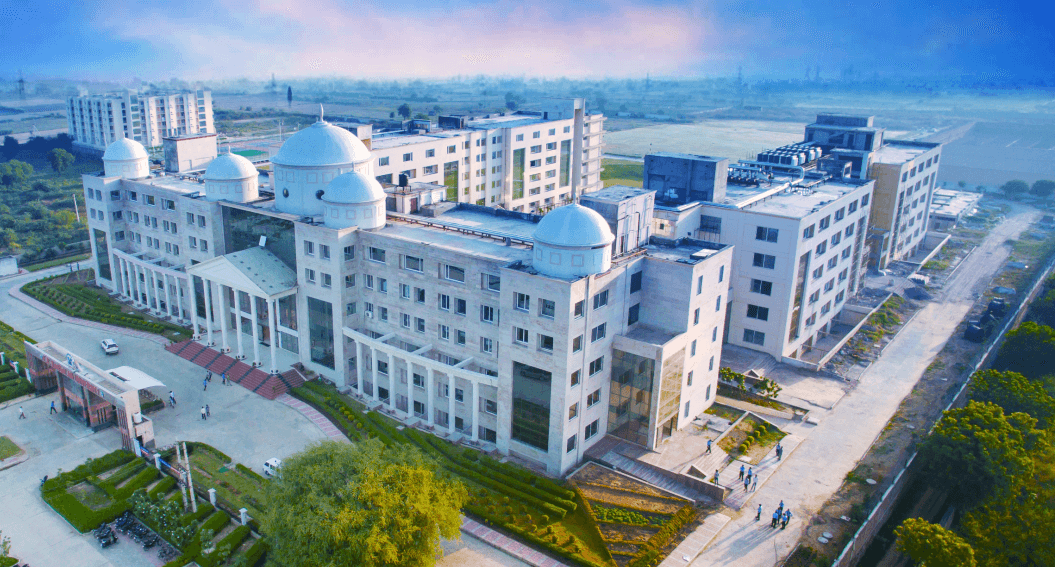
Ph.D. in Physics from K.R. Mangalam University: Eligibility, Entrance Exam, Fee Structure, Admission Process, Subjects, Research Areas, Syllabus, Scholarship & Career Scope
Introduction about Ph.D. in Physics at K.R. Mangalam University
Embarking on a doctoral journey in physics at K.R. Mangalam University opens doors to cutting?edge research, world?class mentorship, and a vibrant scientific community. The university’s state?of?the?art laboratories, interdisciplinary collaborations, and industry tie?ups provide a fertile ground for aspiring physicists to transform theoretical insights into real?world innovations. Whether your passion lies in quantum mechanics, astrophysics, condensed matter, or nanotechnology, K.R. Mangalam University equips you with the tools, resources, and academic rigor to become a leader in the global scientific arena.
Ph.D Admission 2026-2027 & Writing Support Services by Shiksha Research
Eligibility Criteria for Ph.D. in Physics at K.R. Mangalam University
Prospective candidates must satisfy the following minimum requirements:
- Holding a Master's degree (M.Sc.) in Physics or a closely related discipline with a minimum of 55% aggregate (or equivalent CGPA).
- Valid GATE score in Physics (or related paper) is preferred but not mandatory.
- English proficiency – IELTS 6.0 or TOEFL iBT 80 for international applicants.
- Research aptitude demonstrated through a statement of purpose, academic references, and a concise research proposal.
Candidates with a distinguished record of publications, patents, or conference presentations may receive relaxation in eligibility requirements.
Entrance Exam for Ph.D. in Physics at K.R. Mangalam University
K.R. Mangalam University conducts its own Ph.D. Entrance Test (PET) for physics aspirants. The exam assesses:
- Fundamental concepts in Classical Mechanics, Electrodynamics, Quantum Mechanics, and Statistical Physics.
- Mathematical proficiency – differential equations, linear algebra, and complex analysis.
- Analytical reasoning and problem?solving abilities.
The test comprises 100 multiple?choice questions with a duration of 2 hours. Candidates scoring above the prescribed cut?off are invited for a personal interview and a research proposal presentation.
Fee Structure for Ph.D. in Physics at K.R. Mangalam University
| Component | Annual Fee (INR) | Notes |
|---|---|---|
| Tuition & Laboratory Charges | 1,40,000 | Includes access to all labs and research facilities. |
| Registration & Examination Fee | 30,000 | Paid at the time of enrollment. |
| Library & Digital Resources | 10,000 | Unlimited access to e?journals, databases, and inter?library loan. |
| Student Support Services | 5,000 | Career counseling, mentorship, and workshops. |
| Total Approximate Cost (per year) | 1,85,000 | Subject to revision each academic year. |
Scholarships, research assistantships, and industry?sponsored fellowships can significantly offset these costs.
Admission Process for Ph.D. in Physics at K.R. Mangalam University
- Online Application: Fill the web?based application form available on the university portal.
- Document Upload: Submit scanned copies of academic transcripts, certificates, and identity proof.
- Entrance Exam: Appear for the PET or submit a valid GATE score.
- Interview & Proposal Review: Shortlisted candidates are invited for a virtual/onsite interview and to present their research proposal.
- Final Selection & Offer Letter: Successful candidates receive an admission offer along with details of fee payment and scholarship eligibility.
Ph.D. Subjects and Specializations in Physics at K.R. Mangalam University
The doctoral program offers a spectrum of specializations tailored to emerging scientific challenges:
- Quantum Optics and Photonics
- Condensed Matter Physics and Nanostructures
- Theoretical High?Energy Physics
- Astronomy and Astrophysics
- Plasma Physics and Fusion Energy
- Computational Physics and Data?Driven Modeling
- Materials Science and Advanced Functional Materials
Students can also pursue interdisciplinary tracks integrating physics with bio?engineering, environmental science, or artificial intelligence.
Research Areas in Physics at K.R. Mangalam University
Faculty members lead cutting?edge projects in the following domains:
- Quantum Information Processing and Quantum Computing.
- Renewable Energy Materials – perovskite solar cells, thermoelectrics.
- Dark Matter Detection and Cosmology.
- Spintronics and Magnetoelectric Devices.
- High?Performance Computing for Large?Scale Simulations.
- Biomedical Imaging using Advanced Physics Techniques.
Collaborations with national laboratories, ISRO, DRDO, and leading global universities broaden the research impact.
Documents Required for Ph.D. in Physics at K.R. Mangalam University
| Document | Format | Remarks |
|---|---|---|
| Academic Transcripts (M.Sc. & B.Sc.) | PDF (scanned) | Original plus attested copy. |
| GATE Score Card (if applicable) | Valid for the year of admission. | |
| Research Proposal (2?3 pages) | Clearly state objectives, methodology, and expected outcomes. | |
| Letters of Recommendation (minimum 2) | From academic supervisors or industry mentors. | |
| Proof of English Proficiency | IELTS/TOEFL score report. | |
| Identity Proof (Passport / Aadhar) | Government?issued ID. |
K.R. Mangalam University Ph.D. Syllabus for Physics
The doctoral syllabus is designed to blend rigorous coursework with intensive research. Core modules typically include:
- Advanced Quantum Mechanics (4 credits)
- Statistical Mechanics & Thermodynamics (3 credits)
- Computational Methods in Physics (3 credits)
- Research Methodology & Scientific Writing (2 credits)
- Specialized Electives (choose 2–3 based on research focus)
In addition to coursework, candidates must complete:
- Annual progress reports.
- Publication of at least two peer?reviewed articles.
- A dissertation defense before an expert panel.
For assistance with thesis preparation, students can avail Thesis and Dissertation Writing Services.
How To Apply for Ph.D. in Physics at K.R. Mangalam University
Follow these steps to submit a successful application:
- Visit the official university admission portal and create a user account.
- Complete the online application form, ensuring all mandatory fields are filled.
- Upload the required documents (see Documents Required section).
- Pay the non?refundable application fee of INR 5,000 via net banking or credit card.
- Schedule the PET (if you are not submitting a GATE score) and confirm your test slot.
- After the exam, monitor your email for interview invitations.
- Accept the admission offer and fulfill any additional documentation for enrollment.
Career Scope and Job Opportunities After Ph.D. in Physics from K.R. Mangalam University
Graduates of the Ph.D. program are highly sought after across academia, industry, and government research labs. Typical career trajectories include:
- Academic Positions: Assistant Professor, Lecturer, or Post?Doctoral Fellow in leading universities worldwide.
- Research Scientist: Roles at ISRO, DRDO, BARC, CSIR labs, and international research institutes.
- Industry Opportunities: Quantum computing firms, semiconductor manufacturers, renewable energy companies, and high?tech startups.
- Data?Intensive Roles: Leveraging physics?based modelling for AI, finance, and healthcare analytics. For data?centric projects, students often turn to Research Data Analysis Services.
- Consultancy & Patent Development: Providing expert advice on technology transfer and intellectual property.
According to recent placement statistics, 78% of Ph.D. graduates secure employment within six months of graduation, with an average salary range of INR 12–20 LPA.
Scholarship for Ph.D. in Physics at K.R. Mangalam University
K.R. Mangalam University offers merit?based and need?based scholarships to support outstanding scholars:
- University Merit Scholarship: 50% tuition waiver for students with a GPA above 8.5/10.
- Research Assistantship (RA): Monthly stipend of INR 25,000 plus tuition exemption for working on faculty?led projects.
- External Fellowships: Opportunities to apply for CSIR, UGC, and INSPIRE fellowships.




