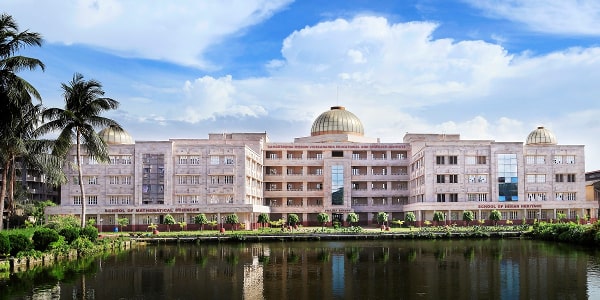
Introduction about Ph.D. in Physics at Ramakrishna Mission Vivekananda Educational and Research Institute
The Ramakrishna Mission Vivekananda Educational and Research Institute (RMVERI) has emerged as a premier hub for advanced scientific inquiry in India. Its Doctoral programme in Physics blends rigorous coursework with cutting‑edge research, empowering professionals to become thought leaders in theoretical, experimental, and applied physics. With state‑of‑the‑art laboratories, collaborations with national research organisations, and a vibrant academic community, RMVERI offers an inspiring environment for scholars aiming to push the frontiers of knowledge.
Eligibility Criteria for Ph.D. in Physics at Ramakrishna Mission Vivekananda Educational and Research Institute
- A Master’s degree (M.Sc., M.Tech., M.E., or equivalent) in Physics or a closely related discipline with a minimum of 55% aggregate (or 5.0 CGPA on a 10‑point scale).
- Candidates with a Bachelor’s degree (B.Sc.) are eligible if they have secured at least 60% aggregate and have cleared the National Eligibility Test (NET) or GATE in Physics.
- English proficiency for international candidates: IELTS 6.0 or TOEFL iBT 80.
- Valid score in the institute’s entrance examination or qualifying national level test (NET/GATE).
Entrance Exam for Ph.D. in Physics at Ramakrishna Mission Vivekananda Educational and Research Institute
RMVERI conducts a comprehensive entrance test that evaluates the candidate’s depth in fundamental physics, analytical reasoning, and research aptitude. The exam comprises:
- Written Test (120 marks): Topics include Classical Mechanics, Quantum Mechanics, Electrodynamics, Statistical Physics, Solid State Physics, and Mathematical Methods.
- Interview (30 marks): Candidates discuss past research, propose potential Ph.D. topics, and demonstrate critical thinking.
Applicants who have cleared UGC NET or GATE in Physics are exempted from the written test and directly invited for the interview.
Fee Structure for Ph.D. in Physics at Ramakrishna Mission Vivekananda Educational and Research Institute
| Component | Annual Fee (INR) | Notes |
|---|---|---|
| Tuition & Laboratory Charges | 45,000 | Includes access to all research labs and equipment |
| Library & Digital Resources | 7,500 | All‑India inter‑library loan and e‑journal subscriptions |
| Exam & Evaluation Fee | 5,000 | Covering internal assessments, seminars, and thesis evaluation |
| Student Services & Welfare | 3,500 | Medical, counseling, and extracurricular activities |
| Total Approximate Cost (per year) | 61,000 | Subject to revision each academic year |
Admission Process for Ph.D. in Physics at Ramakrishna Mission Vivekananda Educational and Research Institute
- Online Application: Complete the registration on the institute’s portal, upload academic transcripts, research proposal (max 1500 words), and supporting documents.
- Entrance Examination: Appear for the written test (if applicable) and subsequent interview.
- Document Verification: Submit original certificates and proof of identity for verification.
- Admission Offer: Successful candidates receive an admission letter with fee details and enrollment instructions.
- Enrollment & Orientation: Pay the fee, attend the mandatory orientation program, and register for courses.
Ph.D. Subjects and Specializations in Physics at Ramakrishna Mission Vivekananda Educational and Research Institute
RMVERI’s Physics department offers a broad spectrum of research specializations, enabling scholars to tailor their doctoral journey:
- Condensed Matter Physics
- Quantum Information & Computing
- Astrophysics & Cosmology
- Particle Physics & High Energy Phenomena
- Optical & Photonic Sciences
- Statistical & Computational Physics
- Plasma Physics & Fusion Energy
Research Areas in Physics at Ramakrishna Mission Vivekananda Educational and Research Institute
The institute collaborates with national laboratories, such as DRDO, ISRO, and the Indian Institute of Science, fostering research in:
- Nanomaterials and low‑dimensional systems
- Quantum entanglement and decoherence studies
- Gravitational wave detection techniques
- Renewable energy devices and photovoltaic materials
- Non‑linear dynamics and chaos theory
- Biophysics and medical imaging technologies
Documents Required for Ph.D. in Physics at Ramakrishna Mission Vivekananda Educational and Research Institute
| Document | Format | Notes |
|---|---|---|
| Academic Transcripts (M.Sc./M.Tech.) | PDF (scanned) | Attested copies only |
| Degree Certificate | PDF (original) | Signed by the awarding university |
| Research Proposal | Word / PDF | Maximum 1500 words, include objectives and methodology |
| NET / GATE Scorecard | Valid for the current academic year | |
| Proof of Identity (Aadhaar / Passport) | Government‑issued ID | |
| Passport‑size Photograph | JPEG (300 dpi) | White background |
Ramakrishna Mission Vivekananda Educational and Research Institute Ph.D. Syllabus for Physics
The doctoral syllabus is structured to provide a solid theoretical foundation followed by intensive research work:
- Core Courses (Year 1): Advanced Quantum Mechanics, Statistical Mechanics, Electrodynamics, Computational Physics, and Research Methodology.
- Elective Modules (Year 1‑2): Choose two electives aligned with your research interest, such as Nanophotonics or High Energy Physics.
- Research Phase (Year 2‑4): Conduct experiments or simulations, publish at least two peer‑reviewed articles, and submit a thesis.
- Seminars & Workshops: Mandatory participation in the institute’s monthly research seminars and annual physics symposium.
How To Apply for Ph.D. in Physics at Ramakrishna Mission Vivekananda Educational and Research Institute
Prospective candidates can follow the step‑by‑step guide below:
- Visit the official RMVERI website and navigate to the “Admissions – Ph.D.” portal.
- Create a new user account with a valid email address.
- Fill in the application form, upload required documents, and pay the non‑refundable application fee (INR 1,500).
- Submit the research proposal and select your preferred specialization.
- Monitor your email for the admit card for the entrance test (if applicable).
- After successful selection, complete the admission formalities within the stipulated deadline.
Career Scope and Job Opportunities After Ph.D. in Physics from Ramakrishna Mission Vivekananda Educational and Research Institute
A doctorate in Physics from RMVERI opens doors to a diverse array of career paths:
- Academic Positions: Assistant Professor, Lecturer, or Research Fellow in leading universities worldwide.
- Research & Development: Scientist roles at ISRO, DRDO, BARC, CSIR labs, and private R&D centers.
- Industry: Senior roles in semiconductor, aerospace, renewable energy, and data‑analytics firms.
- Entrepreneurship: Founding tech start‑ups focused on quantum computing, nanomaterials, or scientific instrumentation.
- Consultancy & Policy: Advisory positions in governmental agencies shaping science and technology policy.
Scholarship for Ph.D. in Physics at Ramakrishna Mission Vivekananda Educational and Research Institute
RMVERI offers several merit‑based and need‑based financial aids:
- Institute Fellowship: Full tuition waiver and a monthly stipend of INR 15,000 for up to four years.
- UGC‑CSIR Junior Research Fellowship (JRF): Awarded to NET/GATE qualifiers, covering stipend and contingency.
- External Scholarships: Eligibility for the Infosys Scholars Programme, TCS Scholarship, and other corporate-sponsored grants.
- Research Project Funding: Funding for specific projects from national agencies such as SERB, DST, and INSA.
FAQs Regarding Ph.D. in Physics at Ramakrishna Mission Vivekananda Educational and Research Institute
- What is the minimum duration of the Ph.D. programme?
- The programme is designed for a minimum of 4 years, with a possibility of extension up to 6 years based on research progress.
- Can I pursue the Ph.D. part‑time while working?
- Yes, RMVERI offers a part‑time option for industry professionals, subject to approval by the department and a flexible schedule for seminars and examinations.
- Is there a provision for international students?
- International candidates are welcomed. They must meet the English proficiency criteria and are eligible for the same scholarships as Indian nationals.
- How many publications are required for thesis submission?
- A minimum of two




